Time to throw away your red pen
Writing can be challenging and intimidating for many of our students. Following are a few ideas to get started using dialogue journals.
The journal can be an inexpensive spiral notebook and you can introduce the student to the idea of dialogue journals by saying: “This is a great way to practice communication” or “We are going to write to each other in the journal and I won’t grade it.”
Students may balk at the idea of writing. If your student wants to earn their GED or Hiset, remind them they will need to be able to write a 5-paragraph essay. If they have talked about improving their writing, encourage them to simply try dialogue journals for a few weeks or months.
Create a safe space for students to explore writing
Ease your student into writing by dispelling the idea that students have to be accomplished writers. Tell them to not focus on perfect spelling or grammar. It’s okay. Just write. One sentence or one paragraph will suffice.
They may never have received this encouragement before. Reports they wrote in school may have been returned with numerous negative comments from teachers.
First entry should be from you
Write a few sentences about yourself. Keep it simple but honest. At the end of the entry, give your student a writing prompt such as:
Tell me a little about your life. Tell me about your family or a friend.
What is your job like?
Nothing too intimidating or intrusive.
During your tutoring session or class, give your students ten minutes to write back to you.
If the student asks to write at home then let them do this. Some students feel more comfortable writing privately. If they return to the next class and have not written, gently push them to do it before beginning your planned lesson. A sentence is enough.
Read their journal entry at home and read it a few times
Do not correct the errors. Do not write in the margins.
Remember that this is a form of communication and in the beginning, you are simply encouraging your student to write. Write a positive comment about their writing and then write back to them.
Your entries should be authentic, warm, and respectful
Give the journal back and let the student read what you wrote.
If you think it helps the student to write during class, then encourage them to do so, especially in the beginning. If you know they will complete it at home then it can be part of the homework. Keep the student’s schedule and obligations in mind when doing this.
Grammar and spelling errors can be addressed
Don’t do this in the journal. Instead, take notes of areas they need to work on. If you see students need to practice using articles correctly or they are having issues with subject/verb agreements then find a grammar lesson or few that addresses that particular area. Choose only one or two at a time. Do not inundate students with these lessons all at once.
If you are tutoring online at the moment you can still share a journal. Create a google doc, title it and turn off the grammar/spelling autocorrect function.
Take a look at What’s Right Rather Than Wrong, an article written by an ABE teacher who shares how she used dialogue journal with her class in order to build their self confidence and self awareness. Another excellent article How I Wish I Was Taught to Write , written by ESOL teacher who was first an ESOL student.
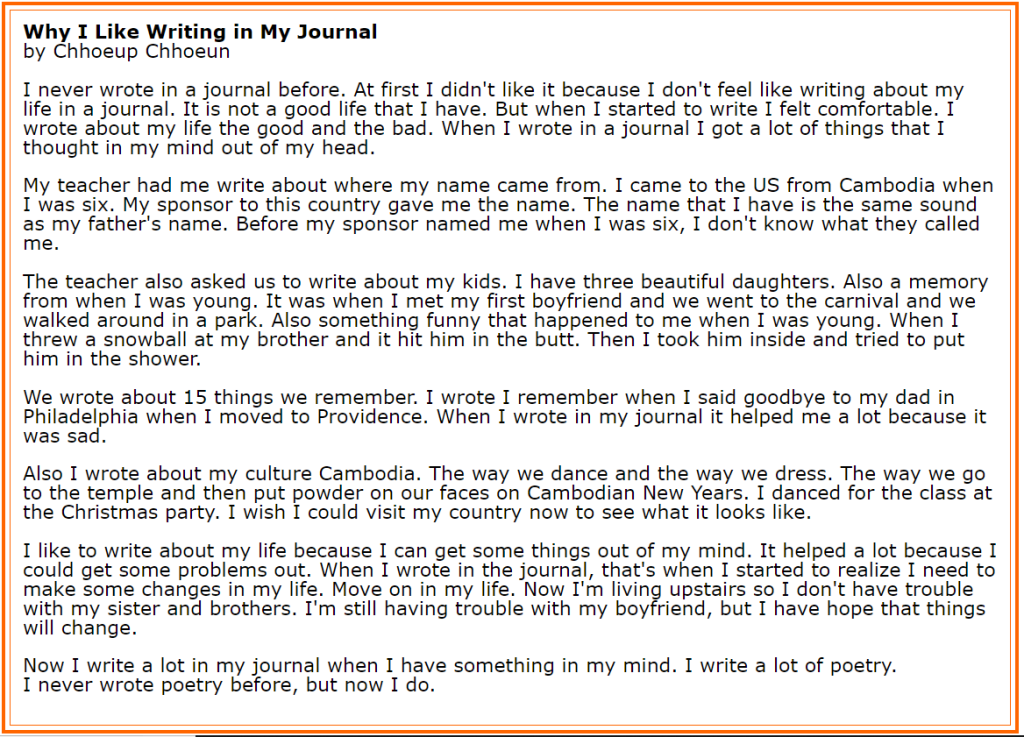
More examples of journal entries from adult learners – NCSALL Sample Journal Entries.
Need some entry ideas? Using Authentic Materials in the ABE Writing Class from SABES
 ABE Tutor Support